
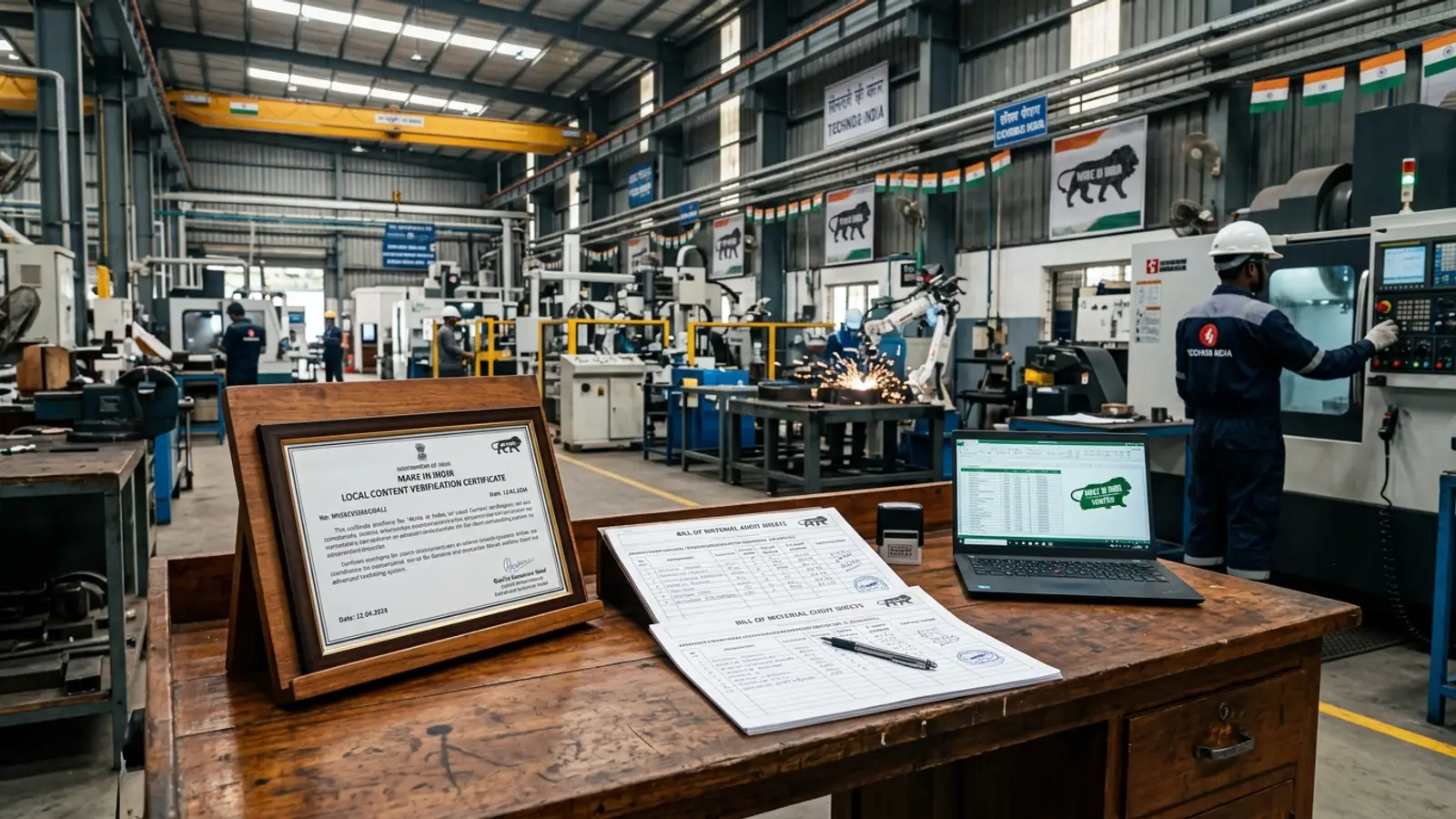
Make in India Certification & Local Content Verification Services in Raipur, Chhattisgarh
Practice Index (9 Sections)
Make in India Certification & Local Content Verification Services in Raipur, Chhattisgarh — Statutory Scope
Chartered Accountancy advisory and audit services in Raipur, Chhattisgarh & Kalahandi, Odisha. Direct partner supervision ensuring full compliance with ICAI standards and applicable statutes.
Under the Public Procurement (Preference to Make in India) Order 2017 (PPP-MII Order) and subsequent revisions issued by the Department for Promotion of Industry and Internal Trade (DPIIT) and Ministry of Finance, public sector undertakings (PSUs), railways, defense establishments, central ministries, and Chhattisgarh state government departments give statutory preference to suppliers who meet local value-addition thresholds.
For tenders exceeding ₹5 Lakhs, bidders are required to provide a self-declaration or a Chartered Accountant (CA) Local Content Certificate (mandatory for tenders exceeding ₹10 Crore or as specified in the Tender Document) verifying the precise percentage of local content in their manufactured goods, work contracts, or services.
At Rabi Agrawal & Associates, our partner-led audit team in Raipur provides rigorous local content percentage audits, Bill of Materials (BOM) verification, cost sheet computations, and statutory CA certificates under the PPP-MII Order 2017 to ensure your tender bids are compliant, verifiable, and protected against disqualification or debarment.
Supplier Classification under PPP-MII Order 2017
The Public Procurement (Preference to Make in India) Order categorizes suppliers into three distinct classes based on the percentage of local value addition in the offered goods, services, or works:
| Supplier Category | Local Content Percentage | Purchase Preference Eligibility | Tender Participation Rights |
|---|---|---|---|
| Class-I Local Supplier | Equal to or greater than 50% (or higher specific nodal ministry threshold) | Eligible for 20% Purchase Preference over L1 non-local suppliers | Primary preference in all Central & State PSU / Government tenders |
| Class-II Local Supplier | Greater than 20% but less than 50% | Not eligible for purchase preference | Eligible to bid in tenders where Class-I preference is not exclusive |
| Non-Local Supplier | Less than 20% local content | No purchase preference | Ineligible for tenders reserved exclusively for local suppliers (below ₹200 Cr) |
Supplier Category: Class-I Local Supplier
Local Content Percentage: Equal to or greater than 50% (or higher specific nodal ministry threshold)
Purchase Preference Eligibility: Eligible for 20% Purchase Preference over L1 non-local suppliers
Tender Participation Rights: Primary preference in all Central & State PSU / Government tenders
Supplier Category: Class-II Local Supplier
Local Content Percentage: Greater than 20% but less than 50%
Purchase Preference Eligibility: Not eligible for purchase preference
Tender Participation Rights: Eligible to bid in tenders where Class-I preference is not exclusive
Supplier Category: Non-Local Supplier
Local Content Percentage: Less than 20% local content
Purchase Preference Eligibility: No purchase preference
Tender Participation Rights: Ineligible for tenders reserved exclusively for local suppliers (below ₹200 Cr)
Calculation Methodology for Local Content Percentage
Local content is defined as the amount of value added in India, which is the total value of the item procured (excluding net domestic indirect taxes) minus the value of imported content in the item (including all customs duties, shipping, and insurance) as a proportion of the total value, expressed as a percentage.
The statutory formula for local content audit applied by our Chartered Accountants is:
- ✓Local Content (%) = `[(Total Cost of Goods/Services - Imported Content Cost - Net Domestic Indirect Taxes) / (Total Cost of Goods/Services - Net Domestic Indirect Taxes)] × 100`
- ✓Included Local Costs: Cost of indigenously procured raw materials, local sub-assemblies, direct labor incurred in Indian factories, domestic freight, manufacturing overheads, factory utilities, and local design/R&D costs.
- ✓Excluded Costs (Imported Components): C.I.F. value of direct imports, imported components purchased from Indian stockists, royalty or technical fees paid abroad, imported software licenses, and overseas testing/certification costs.
- ✓Non-Eligible Items: General office overheads, administrative expenses, financing charges, and profit margins are excluded from both numerator and denominator in strict cost auditing.
Key Procurement Norms & Tender Privileges
Government procurement policy provides substantial competitive advantages to certified Class-I Local Suppliers:
- ✓Global Tender Inquiry (GTI) Restriction: No Global Tender Inquiry can be issued for procurement of goods, services, or works having an estimated value up to ₹200 Crore, reserving these tenders exclusively for Class-I and Class-II local suppliers.
- ✓L1 Purchase Preference Mechanism: If a Class-I Local Supplier is not the L1 bidder, but its quoted price falls within the L1 + 20% margin of purchase preference, it is offered the opportunity to match the L1 price for 50% (or specified quantity) of the tender order.
- ✓Divisible vs Non-Divisible Tenders: Specific evaluation protocols apply depending on whether the procurement quantity can be split among multiple suppliers.
Role of CA Verification & Mandatory Audit Documentation
For high-value bids (generally above ₹10 Crore or as specified in PSU tender conditions like NTPC, NMDC, SAIL, SECL, PWD, or Railways), the procurement authority mandates a certificate from the statutory auditor or a practicing Chartered Accountant.
Our firm conducts a comprehensive audit of the bidder's cost accounts and factory records before issuing the UDIN-verified Make in India Local Content Certificate:
- 01Bill of Materials (BOM) Scrutiny: Verification of component-by-component breakup, purchase invoices, and vendor origin declarations.
- 02Import Customs Verification: Cross-examination of Bills of Entry, customs duty receipts, and ocean/air freight invoices for imported sub-assemblies.
- 03Factory Overheads & Labor Cost Audit: Verification of payroll records, muster rolls, factory electricity bills, and direct operational expenses allocated to the product line.
- 04Vendor Certificate Tracking: Validating back-to-back local content declarations from tier-1 and tier-2 domestic sub-suppliers.
- 05Cost Sheet Certification: Issuance of formal CA Audit Certificate signed with Unique Document Identification Number (UDIN) for submission on procurement portals (GeM / CPPP / PSU portals).
Penalties for False Local Content Declarations
The PPP-MII Order 2017 imposes severe statutory penalties for submitting false or misleading local content certificates:
- ✓Debarment / Blacklisting: Debarment from participating in all public procurement tenders across central and state ministries, PSUs, and autonomous bodies for up to 2 years.
- ✓Financial Recovery: Immediate cancellation of awarded contracts, forfeiture of Performance Bank Guarantee (PBG), and recovery of financial benefits enjoyed.
- ✓Criminal & Statutory Action: Referral to law enforcement authorities under IPC for fraud, misrepresentation, and breach of statutory declaration.
Sectors We Serve in Raipur & Chhattisgarh
We regularly issue Make in India certificates and local content audit reports for manufacturers and contractors in central India:
- ✓Steel & Heavy Machinery: Structural steel fabricators, pipe manufacturers, casting & forging units supplying to SECL, SAIL Bhilai, NMDC, and IRCON.
- ✓Electrical & Transformers: Power transformer manufacturers, HT/LT panel builders, and cable suppliers bidding for CSPDCL, PGCIL, and Railway tenders.
- ✓Solar & Renewable Energy: Solar module assemblers, inverter suppliers, and EPC contractors bidding under CREDA and SECI projects.
- ✓Chemicals & Industrial Supplies: Industrial gas manufacturers, refractories, and water treatment plant EPC contractors.
- ✓Civil & Infrastructure Contractors: EPC companies executing road, bridge, building, and pipe-laying contracts under PWD, NHAI, and Municipal Corporations.
Consult CA in Raipur for Make in India Certification & Local Content Verification Services in Raipur, Chhattisgarh
Visit our Head Office at GF-28, Shyam Plaza, Pandri, Raipur or connect directly with our Chartered Accountant partners for end-to-end advisory and statutory compliance.
When is a Chartered Accountant Make in India Certificate mandatory for tenders?
What is the difference between Class-I and Class-II Local Suppliers?
How is local content calculated for goods containing imported raw materials?
Can imported components bought from a local Indian distributor count as local content?
Are Make in India certificates issued by Rabi Agrawal & Associates verifiable online?
Partner-Led CA Consultation
Speak directly with CA Rabi Agrawal for expert advisory, audit certification, and compliance filing.
Office Locations:
• Raipur (Head Office):Shyam Plaza, Pandri →• Kalahandi (Branch): Main Road, Jayapatna🕒 Mon–Sat: 10:00 AM – 7:30 PM
Recommended Next Practice Areas for Your Business
Explore key regulatory registrations, recurring compliance filings, and government industrial subsidies related to this practice.
GeM Portal Vendor Registration & Bid Advisory
Explore GeM Portal Vendor Registration & Bid Advisory compliance, registration, and advisory requirements.
CA Certification Services in Raipur
Explore CA Certification Services in Raipur compliance, registration, and advisory requirements.
MSME Udyam Registration & Payment Protection
Explore MSME Udyam Registration & Payment Protection compliance, registration, and advisory requirements.
Discuss your tax, audit or compliance requirements with our partners.
Connect directly with Rabi Agrawal & Associatesfor statutory audit, taxation & corporate advisory.